



Since 4 March 2025, safety clearances around power lines in Vietnam are governed by Decree No. 62/2025/ND-CP, which replaces Decrees No. 14/2014/ND-CP and 51/2020/ND-CP. Many familiar figures are unchanged, but home owners, investors and contractors should note several new points: high voltage now means above 1 kV, covered conductors have their own clearances, there are minimum heights where lines cross busy areas, and new limits apply to kites and drones near power lines.
DOBICO has summarised the main clearances by voltage level so that residents and clients can check them quickly when building, repairing a roof, planting trees or working near power lines.
Legal basis
- Electricity Law No. 61/2024/QH15 dated 30 November 2024.
- Decree No. 62/2025/ND-CP dated 4 March 2025 detailing the Electricity Law on protection of power works and safety in the electricity sector, effective from the date of signing.
Discharge safety clearance is the minimum distance from a live part to the nearest point of any equipment, tool, vehicle, structure, tree or flying object. A covered conductor is a conductor with insulation rated at least at the line's phase voltage. The clearances below apply at maximum conductor sag (the corridor width is measured with the conductor at rest).
1. Safety corridor of overhead lines
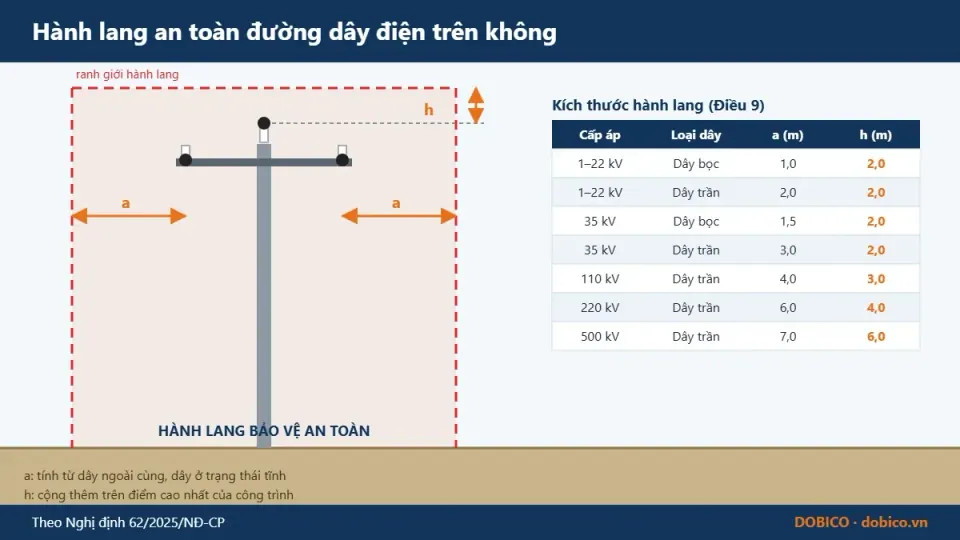
The corridor width is measured from the outermost conductor on each side; its height runs from the bottom of the pole foundation to the highest point of the structure plus a vertical clearance (Article 9).
| Voltage | Conductor | Width each side (m) | Added height (m) |
|---|---|---|---|
| Above 1 kV to 22 kV | Covered | 1.0 | 2.0 |
| Above 1 kV to 22 kV | Bare | 2.0 | 2.0 |
| 35 kV | Covered | 1.5 | 2.0 |
| 35 kV | Bare | 3.0 | 2.0 |
| 110 kV | Bare | 4.0 | 3.0 |
| 220 kV | Bare | 6.0 | 4.0 |
| 500 kV | Bare | 7.0 | 6.0 |
For cables above 1 kV laid on the ground or strung overhead, the corridor is 0.5 m from the outer surface of the outermost cable.
2. Houses and structures inside the corridor
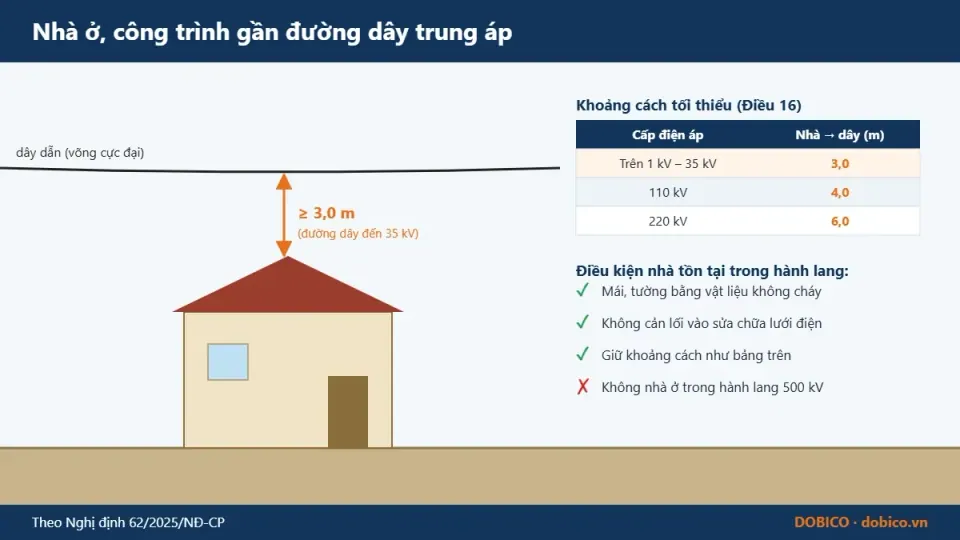
A house or structure may remain inside the corridor of a line up to 220 kV only if all three conditions are met (Article 16):
- The roof and outer walls are made of non-combustible materials and the structure is safe.
- It does not block access for inspection, repair or replacement of the grid.
- Every part of the building keeps at least the clearance below to the nearest conductor.
| Voltage | Minimum clearance building to conductor (m) |
|---|---|
| Above 1 kV to 35 kV | 3.0 |
| 110 kV | 4.0 |
| 220 kV | 6.0 |
For 220 kV lines, the electric field must also be below 5 kV/m outside and no more than 1 kV/m inside the house (measured 1 m above ground), and metal structures must be earthed. Houses near a 500 kV corridor must keep the electric field below 5 kV/m.
When using the roof (drying laundry, repairs, installations, etc.), nothing may come closer to the line than the following (Article 4.2):
| Voltage | Conductor | Minimum clearance (m) |
|---|---|---|
| Above 1 kV to 22 kV | Covered | 1.0 |
| Above 1 kV to 22 kV | Bare | 2.0 |
| 35 kV | Covered | 1.5 |
| 35 kV | Bare | 3.0 |
| 110 kV | Bare | 4.0 |
| 220 kV | Bare | 6.0 |
Before building, repairing or renovating inside the corridor, owners must contact the local power company to agree on safety measures; building permit authorities must also consult the grid operator.
3. Working near lines: cranes, scaffolding, machinery
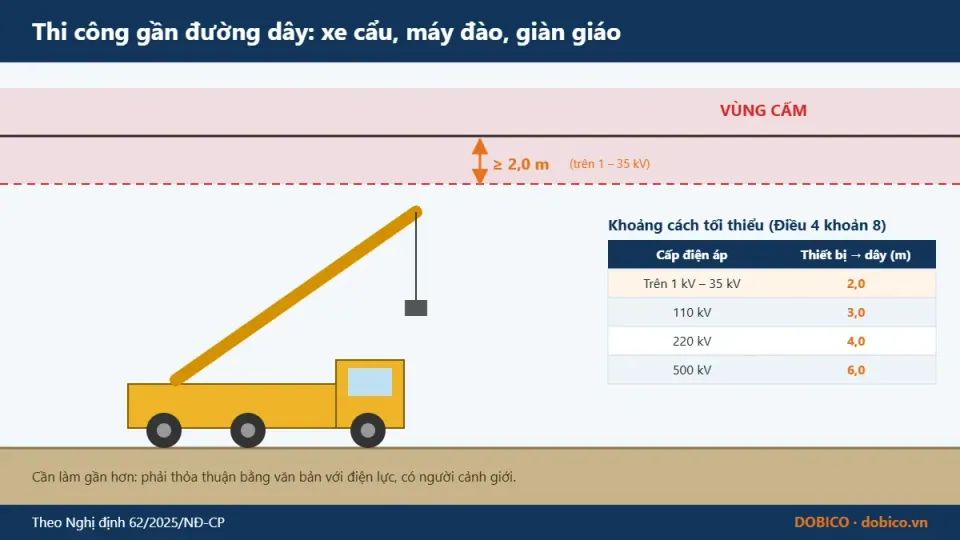
This is where most accidents happen. When working in or near the corridor, equipment, tools and vehicles must not come closer to the conductor than the following (Article 4.8):
| Voltage | Minimum clearance (m) |
|---|---|
| Above 1 kV to 35 kV | 2.0 |
| 110 kV | 3.0 |
| 220 kV | 4.0 |
| 500 kV | 6.0 |
If work closer than this is unavoidable, a written agreement on safety measures with the power company is required. Filling earth, stacking materials or dumping waste that reduces ground clearance is prohibited, and antennas, clotheslines, scaffolding, net houses or billboards must not be placed where they could fall onto the line.
4. Trees inside and outside the corridor
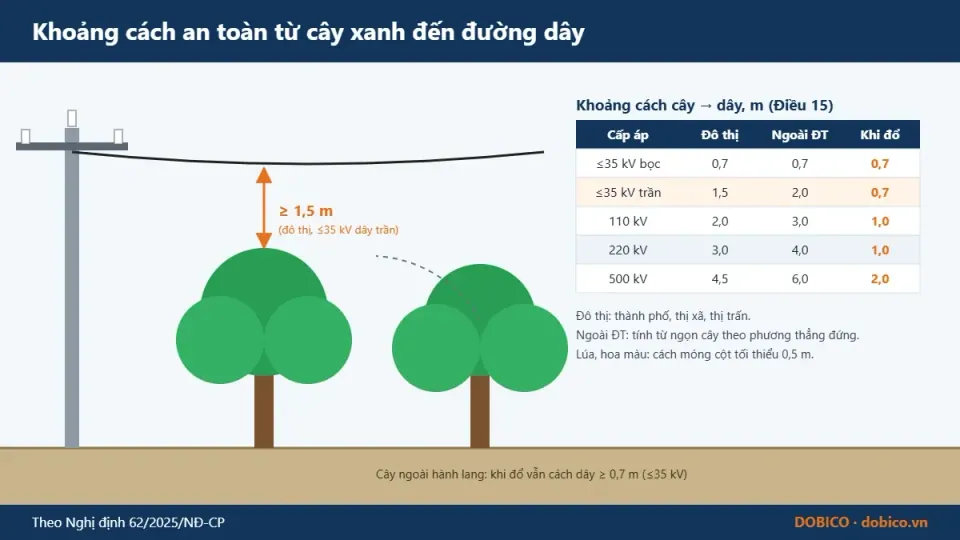
Trees inside the corridor must keep a clearance to the conductor; trees outside the corridor must not come closer than the limit even if they fall (Article 15).
| Voltage | Conductor | In cities and towns (m) | Outside urban areas, from treetop (m) | Falling tree outside corridor (m) |
|---|---|---|---|---|
| Up to 35 kV | Covered | 0.7 | 0.7 | 0.7 |
| Up to 35 kV | Bare | 1.5 | 2.0 | 0.7 |
| 110 kV | Bare | 2.0 | 3.0 | 1.0 |
| 220 kV | Bare | 3.0 | 4.0 | 1.0 |
| 500 kV | Bare | 4.5 | 6.0 | 2.0 |
Tree owners must regularly trim trees at risk of breaching the clearance. Rice and crops may be grown no closer than 0.5 m from pole and stay foundations.
5. Road crossings and crowded areas
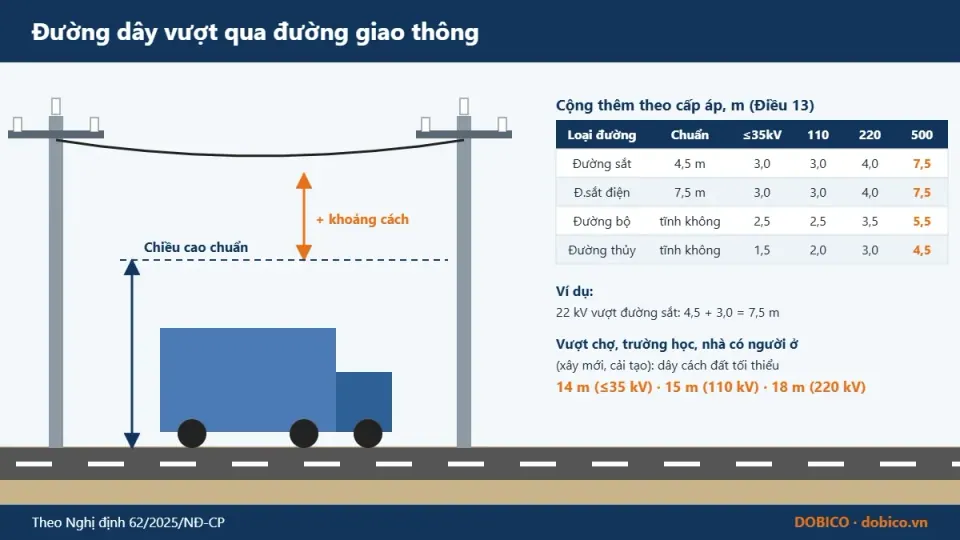
Where a line crosses a transport route, the minimum conductor height (lowest point, maximum sag) equals the standard height for that route plus the discharge safety clearance (Article 13).
| Route | Standard height | Added: above 1 kV – 35 kV | 110 kV | 220 kV | 500 kV |
|---|---|---|---|---|---|
| Railway | 4.5 m | 3.0 m | 3.0 m | 4.0 m | 7.5 m |
| Electrified railway | 7.5 m | 3.0 m | 3.0 m | 4.0 m | 7.5 m |
| Road | Road clearance height | 2.5 m | 2.5 m | 3.5 m | 5.5 m |
| Inland waterway | Waterway clearance by class | 1.5 m | 2.0 m | 3.0 m | 4.5 m |
Example: a 22 kV line crossing a railway must be at least 4.5 + 3.0 = 7.5 m high. Vehicles taller than the permitted height must contact the power company before passing.
When building or upgrading a line over occupied houses, markets, schools, hospitals, bus stations or amusement areas, the lowest conductor must be at least 14 m (above 1 kV to 35 kV), 15 m (110 kV) or 18 m (220 kV) above ground, using steel or reinforced concrete poles, double insulation and no conductor joints within the span (Article 8.5).
6. Underground cables and substations
Underground cables (Article 10): the corridor extends from the outermost cable sheath on each side, and down to 1.5 m below the lowest point of the sheath. For cables in a trench, the corridor is the outer face of the trench.
| Cable location | Width each side (m) |
|---|---|
| Stable soil | 1.0 |
| Unstable soil | 1.5 |
| Rivers and lakes without vessel traffic | 20 |
| Rivers and lakes with vessel traffic | 100 |
| Sea | 100 |
Anyone excavating or building inside an underground cable corridor must notify the cable operator at least 10 days in advance.
Substations (Article 11):
- Without a fence: the corridor is 2.0 m (above 1 kV to 22 kV) or 3.0 m (35 kV) from the nearest live part.
- With a fence: the corridor extends to the outer edge of the fence foundation, with added height of 2.0 m (up to 35 kV), 3.0 m (110 kV), 4.0 m (220 kV) or 6.0 m (500 kV).
- Compact or metal-enclosed substations: the corridor extends to the outer surface of the enclosure.
7. Kites and drones near power lines
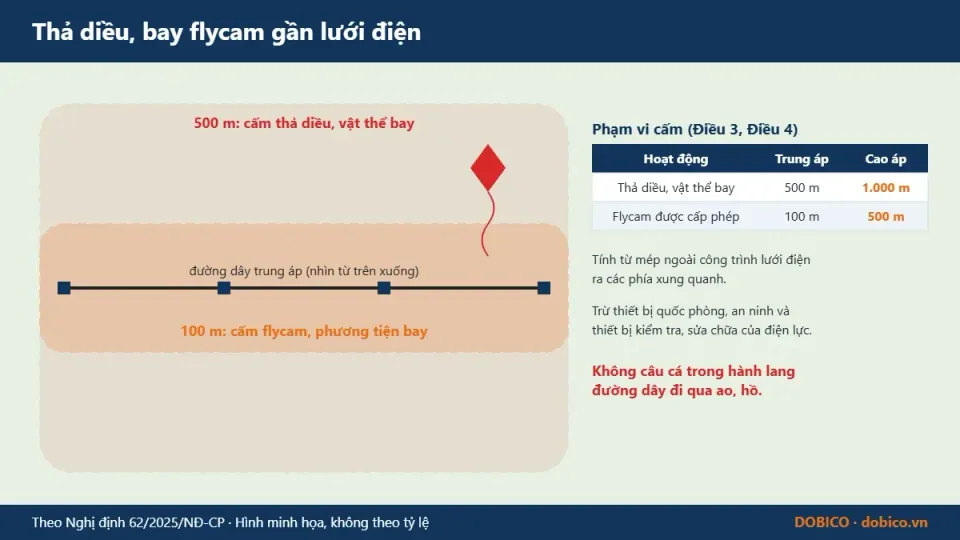
| Activity | Medium-voltage grid | High and extra-high voltage grid |
|---|---|---|
| Kites and flying objects (Article 4.6) | Prohibited within 500 m | Prohibited within 1,000 m |
| Licensed aircraft and drones (Article 3.6) | Must stay outside 100 m | Must stay outside 500 m |
Distances are measured from the outer edge of the grid works. Exceptions apply to defence and security equipment and to power company equipment used for inspection and repair. Fishing is also prohibited inside the corridor where a line crosses a pond or lake.
Key reminders
- Covered conductors are not fully safe. The covering only reduces the corridor width; touching them can still cause electric shock.
- Planning to build, add a floor, install a metal roof or put up a billboard near a line? Ask the local power company first rather than after construction.
- If you see trees touching lines, sagging conductors or leaning poles, report it to the power company immediately; do not climb or cut them yourself.
- When hiring cranes or excavators near lines, assign a safety watcher and keep the clearances in section 3.
How DOBICO can help
DOBICO Construction Installation JSC surveys sites, advises on solutions and carries out relocation, raising and upgrading of power lines and substations to meet the safety corridor requirements of Decree 62/2025/ND-CP, and prepares agreement documents with the power company for construction near the grid in Ho Chi Minh City and Dong Nai.
Contact: Hotline 0888 979 111 · Email dobico@dobico.vn
Source: Decree No. 62/2025/ND-CP (full text, Vietnamese). Illustrations are in Vietnamese and not to scale.